

Advancing translational researcher and drug testing
Speakers: Silvia Scaglione (React4life / Università degli Studi di Genova)
Summary: Silvia focuses on how MPS can bridge the gap between conventional static cultures and in vivo studies, supporting more predictive assessment of drug efficacy, toxicity, permeability, immune interactions, and tissue response. Particular attention is given to the value of dynamic flow, modular tissue integration, and multi-endpoint analysis in improving biological relevance and translational interpretation.
Neuronal systems & drug discovery
Speakers: Cláudia Almeida (NOVA Medical School / iNOVA4Health), Sandra Almeida (Co-Lab AccelBio) and Ricardo Viais (Co-Lab AccelBio)
Summary: Cláudia talks about Developing human neuronal microphysiological systems to study early mechanisms of Alzheimer’s disease and Sandra and Ricardo focus on the acceleration of drug discovery to turn ideas into investable and impactful assets.
Organoid manufacturing & development of nasopharynx-on-chip
Speakers: Krzysztof Wrzesinski (CSO and co-founder of CelVivo) and Carina Valente (ITQB NOVA)
Summary: Krzysztof talks about organoid manufacturing with ClinoStar technology and Carina focuses on the development of a nasopharynx-on-chip model to study Streptococcus pneumoniae colonization
Reconstructed skin models for pigmentation and cutaneous melanoma research
Speakers: Duarte Barral (NOVA Medical School)
Summary: Duarte talks about 3D skin/epidermis models for studies of pigmentation, disease modelling and cutaneous melanoma research.
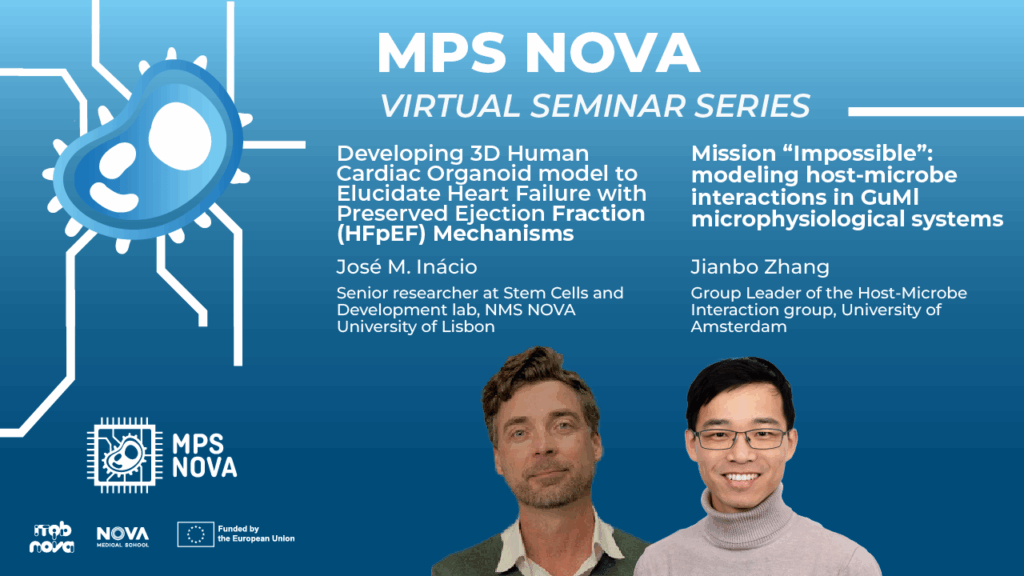
Next Virtual Seminar: September 18th, 2pm (WET)
Exploring Advanced Therapeutic Development Using Organoids
Speakers: Jianbo Zhang (University of Amsterdam), José Manuel Inácio (NMS, Nova University of Lisbon)
Summary: Jianbo will focus on how gut microbes influence human health by presenting intestinal organoids and the Gut-Microbe-Immune (GuMI) system, a platform that mimics physiologically relevant interactions between gut bacteria, intestinal cells, and immune cells.
José will focus on the most prevalent form of heart failure worldwide—HFpEF—and present their strategy to develop a physiologically relevant human cardiac organoid (cardioid) model, aimed at improving mechanistic understanding and accelerating preclinical drug development.
Read the full abstracts and register here until September 16th (5 pm).
Advanced therapeutic development using Organoids: retinal diseases and colorectal cancer
Speakers: Sandra Tenreiro (NMS, Nova University of Lisbon), Bruno Pereira (i3S, University of Porto)
Summary: Sandra Tenreiro presents how her team has developed innovative 3D human retinal organoid models that mimic early diabetic retinopathy. These models enable the study of neurodegeneration, inflammation, and regeneration, as well as the evaluation of novel therapeutic compounds and gut-derived extracellular vesicles.
Bruno Pereira discusses how his team uses colorectal cancer organoid models to investigate RNA-level regulatory mechanisms, focusing on the role of RNA-binding proteins in tumor progression and therapy resistance.
Modelling Bacterial Pneumonia Infection Dynamics in Lung-on-chip: a Comparative Study of Legionella pneumophila and Staphylococcus aureus
Speakers: Raquel Portela, ITQB NOVA
Summary: Join Raquel Portela as she investigates how different bacteria drive distinct pneumonia manifestations by examining their interactions with the lung microenvironment using a 3D Lung-on-Chip platform, offering new insights into infection dynamics and host responses under physiologically relevant conditions.
Exploring Advanced 3DCell Models & Organ-on-Chip
Speakers: Catarina Brito (ITQB NOVA and iBET) & Martin Raasch (Dynamic 42)
Summary: How can we enhance preclinical models for advanced therapeutics? And how can researchers get started with Organ-on-Chip (OoC) technology? This session brings together two experts to discuss cutting-edge approaches in 3D cell culture models and OoC innovation.
Catarina Brito shares how her team develops innovative 3D human brain cell culture models incorporating innate immune components to study the effects of advanced therapeutics—from neuroinflammation to tumor microenvironments.
Martin Raasch provides a beginner-friendly guide to integrating Organ-on-Chip technology into research, sharing lessons learned and practical advice from his work at Dynamic42.
Microfluidics and the Future of Organ-on-Chip: Driving Innovation Through Standardization
Speaker: Vânia Silvério (INESC MN)
Summary: The rapid advancement of microfluidics in Organ-on-Chip (OoC) technologies is revolutionizing biomedical research and therapeutic development. But how can we ensure these innovations are reliable, scalable, and widely adopted? Vânia Silvério explores the critical role of standardization in shaping the future of OoC technology.